Data is a variety of information that every company and government can have access to help to understand trends, customers preferences and to predict things as well. It has been collected in different ways and for different reasons. As for example, governments use to collect population’s information to analyse demographic growth and use this information to develop social programs and laws that will be necessary for the near future, such as social security.
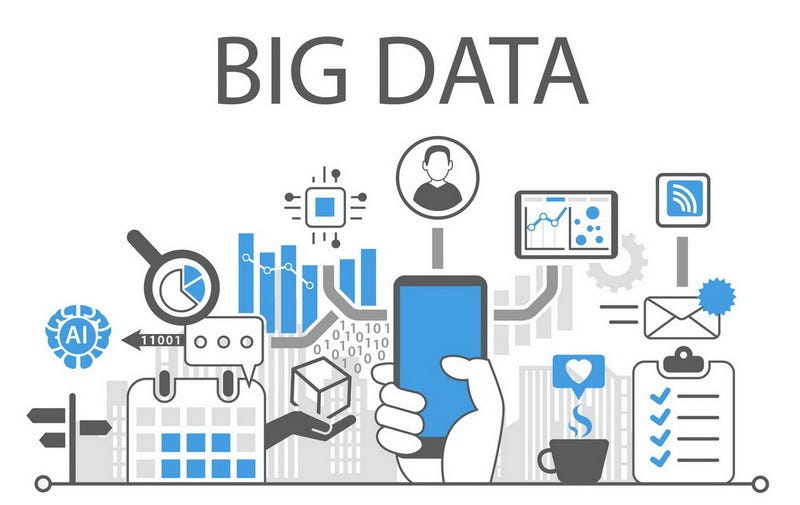
The term Big Data was created in early 2000 and describes a large amount of information/ data. Which involves three types of dimensions, as described for Doug Laney (apud SAS, 2020) volume, velocity and variety. The volume of data is nowadays way wide than before, with numerous sources such as business transactions, smart devices, social media platforms, researches and so on. The other dimension of Data, velocity, comes with the internet of the things influencing on the speed of information is produced and collected, for some kind of business that is a key factor for making the right decisions, like in the financial market. The third dimension, variety, assume that Data comes in all types of formats, and it can be structured such numbers in regular data basis or unstructured such documents, emails, comments on social media and financial transactions.
Analysis of big data allows analysts, researchers and business users to make better and faster decisions using data that was previously inaccessible or unusable (IBM, 2020). Furthermore, for business analysing Data can use advanced tools and technics as machine learning, predictive analytics, data mining, statistics and natural language to obtain a better understanding of both existing uncharted data sources and processed ones. There are many companies which work processing Data and analysing it, however, skilled staff and budgets still obstacles for this huge market. (Colwyn, 2015).
References
IBM, 2020. What is big data analytics? [ONLINE] Available at: https://www.ibm.com/analytics/hadoop/big-data-analytics [Accessed on 22 January 2020].
Colwyn,
S.
2015. What
are the Big Challenges of ‘Big Data’? [ONLINE] Available
at:
https://www.smartinsights.com/digital-marketing-platforms/big-data-digital-marketing-platforms/whats-business-challenges-big-data-digitalinsight/ [Accessed
on 21 January 2020].
SAS,
2020. Big
Data: What
it is and why it matters. [ONLINE] Available
at: https://www.sas.com/en_ie/insights/big-data/what-is-big-data.html [Accessed
on 21 January 2020].
Another
reference
Oracle, 2020. What
Is Big Data? [ONLINE] Available
at: https://www.oracle.com/ie/big-data/guide/what-is-big-data.html [Accessed
on 20 January 2020].
Oracle, 2020. What
Is Big Data? [ONLINE] Available
at: https://www.oracle.com/ie/big-data/guide/what-is-big-data.html [Accessed
on 20 January 2020].
Very Informative !
ReplyDeleteThank You
DeleteIt is well written and explains much about big data 👍🏻
ReplyDeleteThank Gozde!
DeletePretty straight forward and informative. Great job Tiago!
ReplyDeleteThank You Arjun!
DeleteVery well written!
ReplyDeleteThanks Marilia!
DeleteThank you for sharing this information. The Big data is becoming a crucial part of every company, especially in making decisions and creating business strategies.
ReplyDeleteThank you!
DeleteTrue Big Data helps to make better decisions
ReplyDeleteThanks Sam
DeleteA very useful article to understand the basics of big data.
ReplyDeleteThanks for sharing Tiago.
Thanks Sedcan
DeleteThanks for teaching us about big data! Very useful
ReplyDeleteThanks Isabela
DeleteVery well written and informative.
ReplyDeleteThank you!
DeleteNice article,well written.
ReplyDeleteRelevant definition of big data, very clear and well explained
ReplyDeleteThanks Mael!
DeleteGreat insight 👍
ReplyDeleteThank you!
Delete